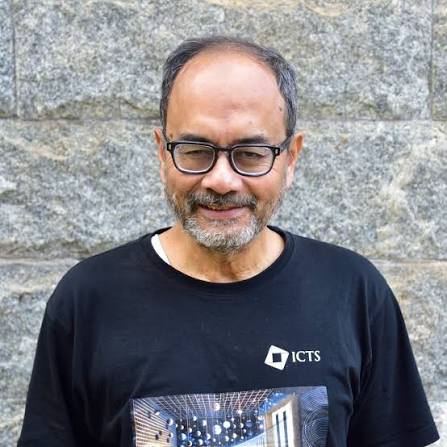

Renowned Indian theoretical physicist Professor Ashoke Sen has been awarded the prestigious Oskar Klein Medal for 2026, becoming the first Indian physicist to receive the international honour. The recognition highlights his pioneering contributions to string theory and his work on some of the most complex questions in modern physics. The announcement was made by the Bengaluru-based International Centre for Theoretical Sciences (ICTS). Sen is currently an ICTS-Infosys Madhava Chair Professor at the International Centre for Theoretical Sciences in Bengaluru. He is internationally recognised for research that has significantly advanced the understanding of string theory, black-hole entropy and string field theory.
Major Contributions to Modern Physics
Professor Sen’s research has played an important role in shaping modern string theory, a theoretical framework that seeks to explain the fundamental building blocks of the universe and reconcile quantum mechanics with gravity.
Among his major contributions is his work on S-duality, which has helped scientists understand important relationships between different formulations of string theory. His research on the precise counting of black-hole entropy has also advanced efforts to understand the quantum properties of black holes.Sen has additionally made significant contributions to string field theory, strengthening the theoretical foundations of this field. His work has influenced research into the fundamental forces of nature and the relationship between gravity and quantum physics.
Delivers Oskar Klein Memorial Lecture in Sweden
As part of the award, Sen delivered the 2026 Oskar Klein Memorial Lecture, titled “Gravity from Strings and Strings from Gravity,” at Stockholm University’s AlbaNova Centre on October 22, 2026.The lecture explored the connections between string theory and gravity, including how string theory can provide a consistent framework for quantum gravity and help address challenging questions surrounding black holes. The lecture is associated with the annual Oskar Klein Medal, which recognises distinguished contributions to physics.
A Distinguished Career and Several Major Honours
The Oskar Klein Medal adds to a long list of prestigious recognitions received by Professor Sen throughout his scientific career. He received the Breakthrough Prize in Fundamental Physics in 2012 for his contributions to establishing the unifying structure of string theory and the Dirac Medal in 2014.His other honours include the ICTP Prize in 1989, the Shanti Swarup Bhatnagar Prize in 1994, the Infosys Prize in Mathematical Sciences in 2009, the Padma Shri in 2001 and the Padma Bhushan in 2013. He was also elected a Fellow of the Royal Society in 1998.
About the Oskar Klein Medal
Named after Swedish theoretical physicist Oskar Klein, the medal has been awarded annually since 1988 by Stockholm University and the Nobel Committee for Physics of the Royal Swedish Academy of Sciences. It recognises outstanding contributions to physics, and previous recipients have included Nobel laureates Chen-Ning Yang, Steven Weinberg and Hans Bethe. Sen’s achievement marks a significant milestone for Indian science and brings international recognition to India’s contributions to fundamental physics. His work continues to deepen scientific understanding of the universe while inspiring researchers working on some of the biggest questions in modern theoretical physics.